Summary
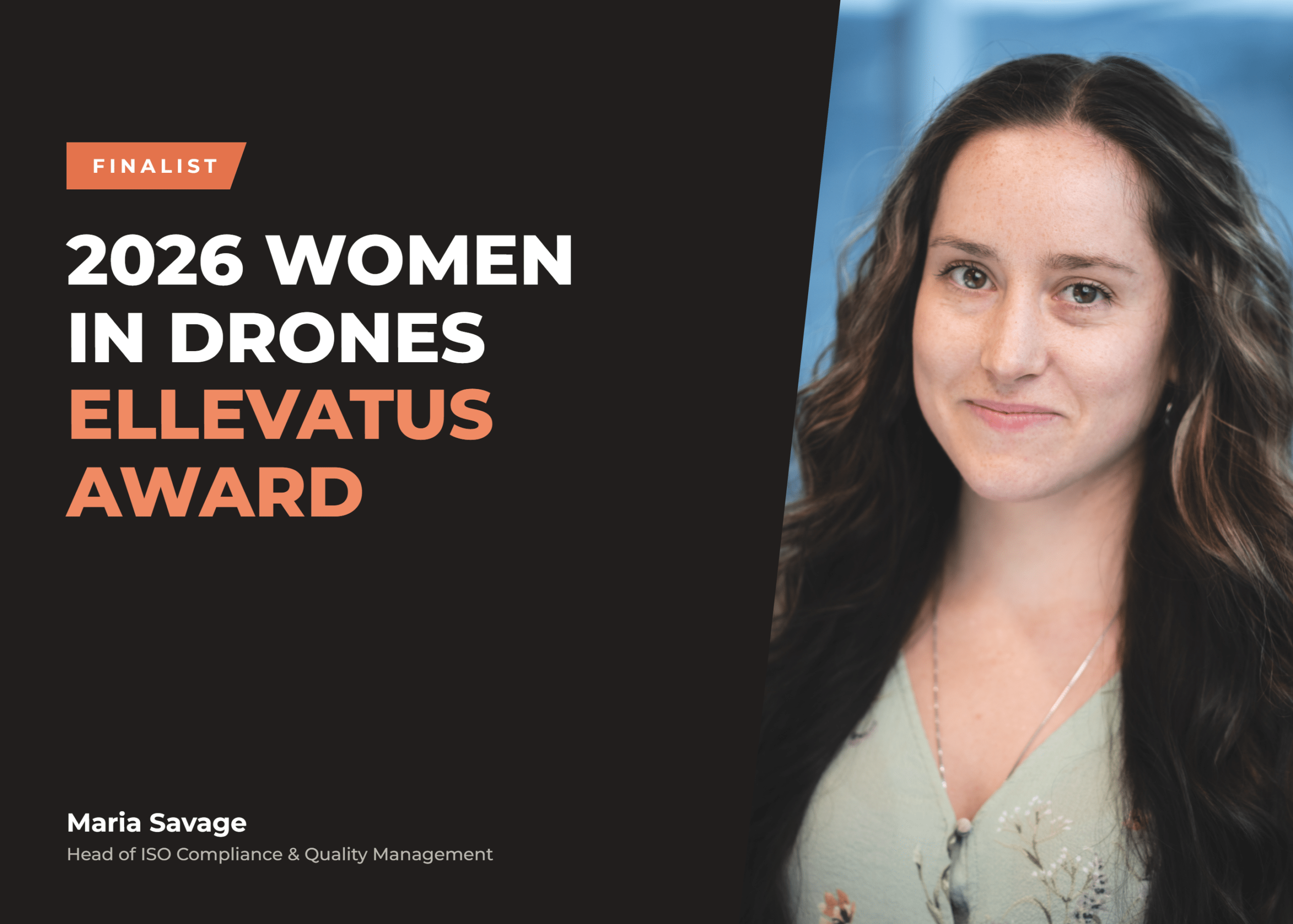
Maria Savage has spent her career doing the least glamorous and most consequential work in Canada’s drone sector: building the systems that let the rest of the industry be trusted. She has been with Altomaxx since Day 1 — not a hire brought in once the company found its footing, but one of the people who gave it that footing. In the years since, she has written the first and still only ISO 21384-3 audit scheme in the world recognized under the international multilateral accreditation framework (formerly the International Accreditation Forum, now Global Accreditation Cooperation), and carried it into operator sites on four continents. Maria has become one of the most influential Canadian voices in RPAS conformity assessment. Not just Canadian, but global drone operators and programs are certified against her work.
Since Day One
It is worth being precise about what “since inception” means in a company like ours. On Day 1 there is no compliance department to join. There is no template, no precedent, no reporting line, and no guarantee the thing you are building will still exist in eighteen months. Whoever takes on quality and compliance in that environment is not administering a system — they are deciding, largely alone, what the system will be, and then living with those decisions for a decade.
Maria made those decisions. The structure of Altomaxx’s certification division, the discipline of its documentation, and the standard of evidence it holds itself to are hers. That work is invisible when it is done well, which is exactly why it so rarely gets recognized. It is also the reason Altomaxx was able to achieve and hold accreditation from the Standards Council of Canada under ISO/IEC 17065:2012 — an accreditation that is not granted to organizations with good intentions, but to organizations that can demonstrate, on audit, that their processes are impartial, competent, repeatable, and documented to a level most companies have never had to meet. As well, Maria has led audits allowing Altomaxx to become the first company in Canada to be DNV Certified, Lloyd’s Register Certified and ABS Recognized for Remote Inspection Techniques for Maritime Vessels and Floating Platforms, a pillar of where Altomaxx stands today.
The Scheme: First in the World, and Still the Only One
ISO 21384-3 sets out operational requirements for unmanned aircraft systems. It is a genuinely useful standard. But a standard, by itself, certifies nothing and nobody. It describes an outcome; it does not tell an auditor how to determine whether an operator on the other side of the world has actually achieved that outcome, or how to reach the same conclusion twice, or how to defend that conclusion to a regulator who disagrees.
Closing that gap is the work of a certification scheme, and it is far harder than it sounds. A scheme has to take clauses written in deliberately general language and convert them into specific, auditable criteria — without narrowing the standard so far that it excludes legitimate operators, and without leaving it so open that two competent auditors reach opposite verdicts on the same evidence. It has to define what constitutes proof. It has to be robust enough to survive an accreditation body’s scrutiny, portable enough to work across radically different national aviation regimes, and practical enough that a working operator can actually comply. And in this case, it had to be built with no precedent anywhere in the world to borrow from, for an industry whose technology and regulation were changing underneath it as it was written.
Maria wrote that scheme. It was the first, and it remains the only one in existence today. Every ISO 21384-3 certification issued anywhere on earth traces back to a framework authored by a Canadian woman working out of a Canadian company. There is no competing methodology — not because nobody wanted the position, but because nobody else has done the work.
The significance for Canada is easy to understate. Conformity assessment is where regulatory influence actually lives. Whoever writes the scheme sets the benchmark — and when an operator in another country wants their ISO 21384-3 certification recognized, they meet a Canadian-authored standard of proof. That is a form of quiet international leadership Canada rarely achieves in aviation, and Maria achieved it essentially single-handedly.
Carrying It Into the Field
Writing the scheme would have been contribution enough. Maria then went and applied it. She has conducted audits on behalf of Altomaxx and the broader industry in Saudi Arabia, the United Arab Emirates, across Europe, in Central America, and throughout Canada.
That is not a travel record; it is a body of evidence. Each engagement meant landing in an unfamiliar regulatory environment, understanding how it interacts with the standard, and then holding an operator to consistent criteria regardless of local pressure, commercial relationship, or how much the client wanted a particular answer. An auditor’s entire value rests on being willing to write down findings people do not want to read. Maria has done that repeatedly, in jurisdictions where she was frequently the only woman in the room and often the only auditor present with genuine hands-on RPAS depth — and she has done it in a way that left those operators wanting to work with her again.
The cumulative result is that international operators now look to a Canadian scheme, and to Maria personally, as the benchmark. Very few people in this sector, of any gender or nationality, can claim that.
How She Got Here
Maria arrived at this work by an unusual route, and it shows in how she does it. With a background in environmental studies and roots in Newfoundland and Labrador, she began her career in sustainable development and fish stock monitoring with government agencies, before moving into policy and safety program implementation.
That grounding matters more than it might appear. Fisheries science is the discipline of managing a shared resource that no single party owns, where the temptation to over-claim is constant, and where the only defence against bad outcomes is rigorous, independent evidence. It is almost exactly the problem of shared airspace. Maria came into aviation already understanding that a standard is only as good as the proof behind it, and that the person holding the line on evidence is doing the most important job in the room even when — especially when — it makes them unpopular. Her stated motivation has not changed either: she works on RPAS technology because she believes long-term planetary sustainability depends on it.
When Maria interviewed, she was not the most qualified candidate. But she sent me an email the same evening, and all it said was: “for what I lack in experience, I will more than make up for in effort.” That is what got her an offer the next day, to start immediately. A decade on, it remains the most accurate self-assessment anyone has ever given me.
A Canadian Pioneer in Policy and Compliance
Domestically, Maria has helped move the Canadian conversation past “can we legally fly this?” toward the harder and more mature questions: how operational competence is demonstrated, how it is independently verified, and how it is maintained over years rather than claimed once. That shift — from permission to assurance — is what turns an emerging sector into a real industry that insurers, regulators, and serious clients can underwrite.
As Head of ISO Compliance & Quality Management at an accredited certification body, she works at the seam between regulation and practice, and she has been notably generous with what she knows. She has shared it through webinars, industry education, and direct guidance to operators trying to reach a standard they had no roadmap to before she drew one. She has never treated her expertise as a moat.
Why She Deserves the Ellevatus Award
The Ellevatus Award recognizes the accomplishments of Canadian women in a rapidly emerging and evolving sector. Maria Savage did not simply accomplish things within that sector. She built infrastructure the sector now stands on, she built it first, and she built it to a standard that the rest of the world adopted by default because there was nothing better anywhere.
She has done it without fanfare, from Day 1, and she is still doing it. It is long past time the industry said so out loud.
Vote for Maria
Voting is now open through the Aerial Evolution Association of Canada. Show your support and help recognize the work Canada’s drone sector stands on.
Vote for Maria
The winner will be announced on September 30, 2026.